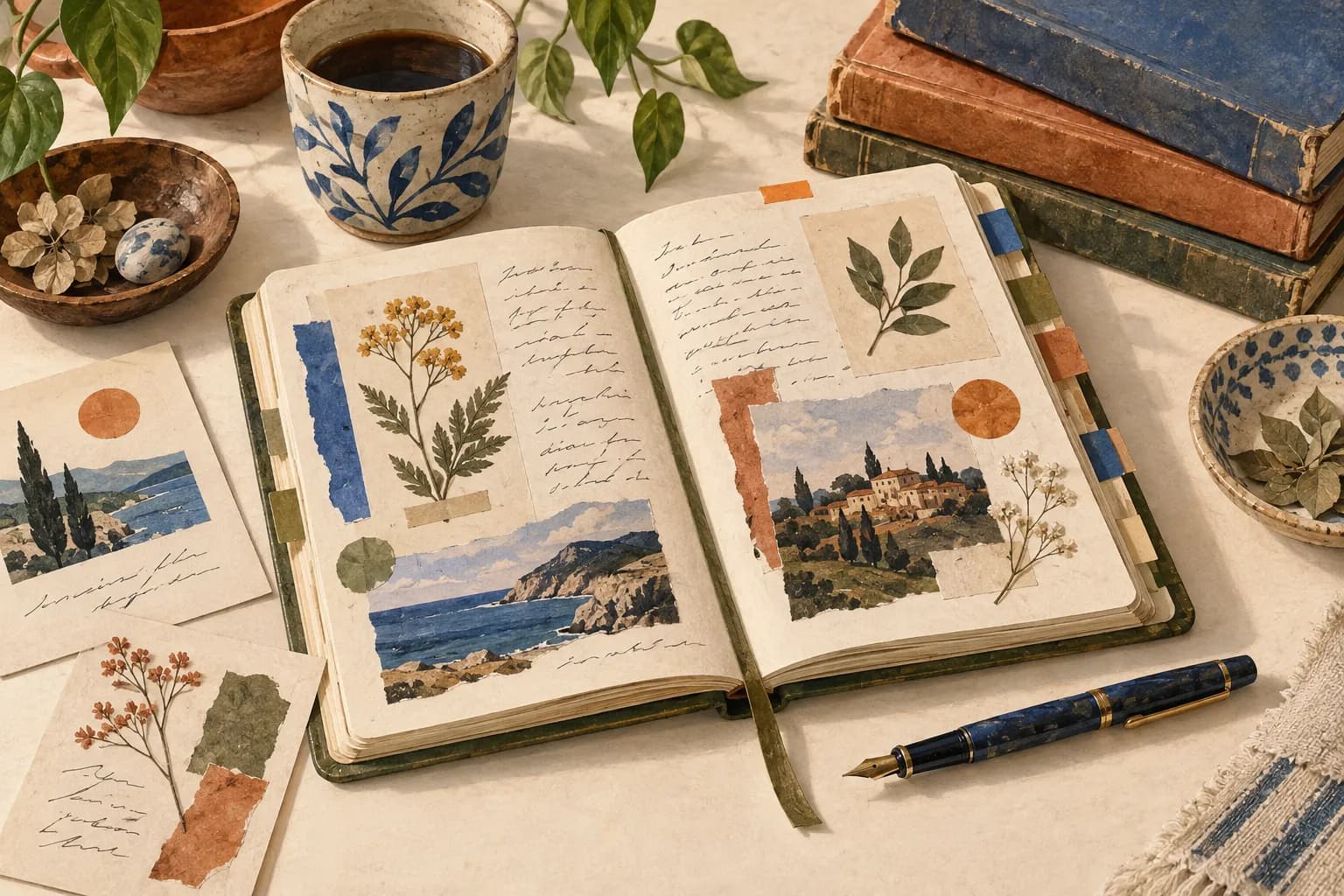
A commonplace book is a notebook where you copy quotes and passages from your reading and arrange them by topic so you can find them again; The Public Domain Review calls it "a kind of personalized encyclopedia of quotations" (Public Domain Review). John Locke published a method for indexing one in 1685.
Below: where it comes from, how Locke's index worked, who kept one, and what a personal reading issue borrows from a magazine, a notebook and an archive.
This guide is part of A guide to saving articles and reading them later, which organizes every guide on the topic.
What exactly is a commonplace book?
It is "a notebook used to gather quotes and excerpts from one's literary wanderings," in The Public Domain Review's words; Jonathan Swift called it something "a provident poet cannot subsist without," because "great wits have short memories" (Public Domain Review). It does not record your day, like a diary: it records what you read and wanted to keep.
The practice is not a museum curiosity. Harvard Library's "Reading" collection includes commonplace books used by Joseph Conrad, Washington Irving and Victor Hugo (Harvard Library).
John Locke's method for indexing it
Locke developed his system over 25 years of note-taking and published it in French in 1685; the English translation, A New Method of Making Common-Place-Books, came out in 1706, after his death (Public Domain Review). A digitized copy of that 1706 edition is on the Internet Archive (Internet Archive).
The method starts with a blank notebook and a two-page index at the front:
- Every note goes under a head, a keyword (Locke's example is Epistola).
- The index has one cell for each combination of first letter and first vowel: Epistola goes under "E i".
- In that cell you write the page number where that group of heads starts, and you write the note there.
According to The Public Domain Review, this let a two-page index locate a wide range of topics, with less wasted paper than an alphabet with pre-assigned pages and more structure than a purely chronological order (Public Domain Review).
Commonplace notebooks beyond Europe
A 2020 doctoral thesis from Brazil's Federal University of São Carlos studied the phrase notebooks of jurist Rui Barbosa and sociologist Florestan Fernandes: Barbosa preferred loose pages and Fernandes bound notebooks; the first was more speculative and literary in choosing phrases, the second more systematic and didactic (Rosin, UFSCar, 2020). The thesis starts from Seneca's image of reading like bees that gather pollen from flower to flower to make honey.
Magazine, notebook and archive: what each format offers
Comparison made by KeepAnalog from the sources cited and from how its product works.
| | Magazine | Commonplace book | Archive | KeepAnalog personal issue | | --- | --- | --- | --- | --- | | Who selects | The editors | You | The keeper | One person | | What it keeps | Full articles from one outlet | Copied passages and your own notes | Copies to preserve | Full articles from public links you chose | | How it is ordered | By issue | By topic, with an index | By collection or date | By monthly issue | | Does it end? | Yes, each issue closes | No, it grows | No | Yes, each issue closes | | Visible origin | Byline and outlet | Only if you write it down | Yes | Title, author when the page gives one, and site |
A personal issue borrows from the magazine an object with an ending, from the notebook a selection made by one person, and from the archive the visible origin of each text. Unlike a commonplace book, it does not hold hand-copied passages or your notes: it holds the articles you chose. What it is and is not, in detail, is in what is a personal reading issue?.
KeepAnalog turns eligible public links (HTML pages or PDFs) chosen by one person into a monthly printed issue, currently in Argentina only; there is no delivery to the United States yet. Nothing is printed or charged until the person approves their issue.
How to start a commonplace book with Locke's method
Steps put together by KeepAnalog from the method described above:
- Use a notebook with numbered pages and leave the first two blank for the index.
- Every time you copy a passage, write the author, the title and where it came from underneath.
- Give it a head and enter it in the index by its first letter and first vowel.
- Check the index before you search your memory: that is what it is for.
If you mark pages as you read, does highlighting help? explains when it helps and when it does not.
Frequently asked questions
What is the difference between a commonplace book and a journal?
A journal records what happens to you; a commonplace book gathers quotes and passages from what you read, arranged by topic so you can come back to them (Public Domain Review).
How do you organize a commonplace book?
By topic. Locke's method uses a two-page index with one cell for each combination of first letter and first vowel of every head (Public Domain Review; Internet Archive).
Who kept commonplace books?
Locke and, before him, John Milton (Public Domain Review); Harvard holds those used by Joseph Conrad, Washington Irving and Victor Hugo (Harvard Library). In Brazil, Rui Barbosa and Florestan Fernandes kept their own phrase notebooks (Rosin, UFSCar, 2020).
What does a personal issue borrow from a magazine, a notebook and an archive?
From the magazine, being a printed object that ends; from the notebook, being chosen by one person; from the archive, keeping each article's title, author and source site. If you save articles and never return to them, start with saving is not returning.